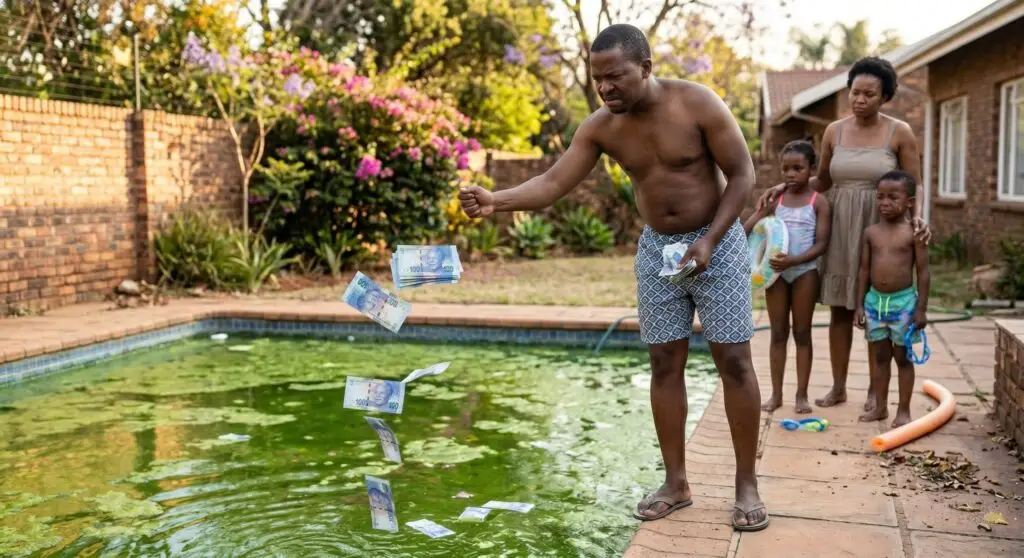
Open up almost any pool filter in South Africa and you’ll find a bed of sand doing the heavy lifting for your whole circulation system. The catch is that sand gets a little worse at that job every season it stays in the tank. Glass media holds its performance. That single fact is why glass has moved from “nice alternative” to the sensible default whenever media needs replacing.
Filter media is easy to forget about. It’s hidden in a tank, it never touches the pool directly, and it isn’t the kind of thing anyone shows off. Yet every litre your pump moves is forced through that bed, and what the bed holds back decides whether your water merely looks clean or genuinely is.
A useful way to picture it: if the pump is the heart of the pool, the media is the liver. The pump only keeps water moving — it doesn’t purify anything. The media is what pulls the impurities out before the water returns to the pool. Fit the most powerful pump you can find and you’ll still be swimming in flat, tired water if the filtering layer has stopped doing its work.
That’s why a media change matters. It’s the one moment you get to upgrade the part that does the actual cleaning — and reaching for another bag of sand throws that opportunity away.
So What Is Filter Glass?
Filter glass is made from 100% recycled soda-lime glass — think bottles and jars — that’s been washed, crushed and graded to an exact particle size for pool filtration. It sits in the tank in the same spot the sand used to, and nothing about your pump, multiport valve or pipework has to change.
What really sets it apart is grain shape. Filter sand comes from quarries or rivers, where millions of years of erosion have worn each grain smooth and round. Glass is crushed, so its particles are jagged and uneven. Those sharp, irregular pieces interlock into a bed with much more surface area and many more tiny voids for dirt to lodge in — and they won’t settle into the tight, compacted layers behind most of sand’s trouble.
Where Sand Lets You Down
It isn’t that sand is adequate and glass is a touch nicer. Sand has three well-known weaknesses, and each one gets steadily worse the longer the same sand stays in the tank.
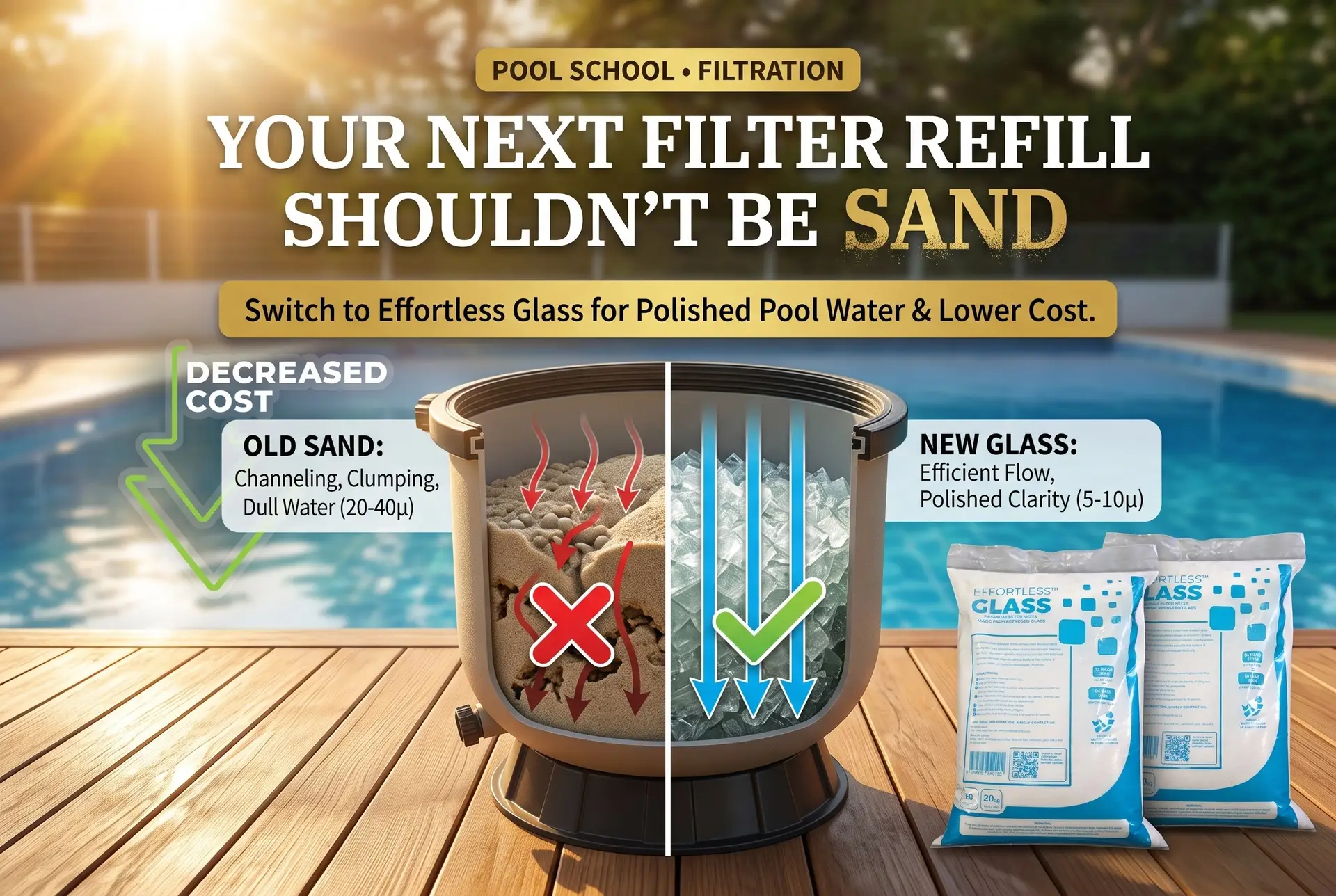
Water finds a shortcut.Flow always follows the easiest route. Given time, it bores narrow paths — known as channelling, tunnelling or wormholing — right through compacted sand. Water racing down one of those paths gets almost no filtration. Meanwhile your pressure gauge reads normally, so you’d never know a portion of the flow is skipping the filter entirely.
Grains wear down and cake together.Each backwash rubs the grains against one another, smoothing them further and breaking some into fines, so they lose the edges that caught dirt to begin with. Body oils, sunscreen and fats then glue the worn grains into lumps that backwashing can’t shift. That’s the reason sand has a lifespan at all — under South African conditions, expect about 18 to 24 months before it noticeably drops off.
Bacteria move in.Ageing sand grains pick up tiny pits and fractures, which make ideal hiding places for bacteria and biofilm. Tucked in deep enough, they survive backwashing and keep consuming your chlorine. Glass offers a hard, smooth, chemically inert surface that gives organic growth nowhere to take hold.
The Payoff in Your Pool
The figure that matters most is how small a particle the media can catch. Standard 20-grade silica sand stops particles down to roughly 20–40 microns. Published data for glass media puts it at around 5–10 microns.
For scale, a human hair measures about 70 microns across, and your eye can no longer pick out individual particles below roughly 40 microns. Sand, in other words, filters right at the limit of visibility, while glass works well beneath it. That invisible haze is precisely what leaves water looking dull, flat or faintly cloudy even when every chemical reading is spot on — something many pool owners chasing clarity through dusty Highveld winters will recognise.
Swap the media and you’ll see the results in four practical ways:
Sparkle, not just sanitised. Stripping out the particles under 10 microns is what produces that crisp, polished look — clear enough to make out the grout lines on the floor of the deep end.
Quicker backwashing. Dirt rests loosely in the glass bed instead of bonding to it, so it lets go fast. A shorter backwash sends less water to waste and means less fresh water to rebalance and dose afterwards.
Less chemical spend. Each gram of organic debris caught physically by the filter is a gram your chlorine no longer needs to oxidise. Stronger mechanical filtration lets your sanitiser concentrate on sanitising rather than burning through dirt.
Consistent performance. Sand peaks in the first week and slides from there. Glass filters just as well in its sixth year as it did on day one.
Will It Fit My Filter?
This is the question that holds most people back, so here’s the straight answer: any filter built for sand will take glass. Glass media is a direct, like-for-like substitute for the sand in a pool sand filter. You don’t need adapters, alterations, new pipework or a different valve — out comes the sand, in goes the glass.
It suits chlorine pools, salt-chlorinated pools and pools on alternative sanitisers alike, because the media’s role is purely mechanical — it sieves particles from flowing water. Glass is also chemically inert, so neither salt nor chlorine can attack it. That makes it a comfortable fit for the salt pools you’ll find everywhere from the Western Cape to the KZN coast and Mauritius.
The one detail to get right is the quantity, and that takes nothing more than basic maths.
Working Out the Quantity
Because glass is lighter than sand, a smaller weight fills the same tank. The manufacturer’s conversion is 120 kg of filter sand = 100 kg of glass media. Put simply: take the sand weight specified for your filter and multiply it by 0.83.
Locally, sand filters are rated in bags, with each bag being a 40 kg bag of sand — so a 3-bag filter holds 120 kg. Here’s how that converts for the usual filter sizes:
Sand-to-Glass Conversion Chart
Effortless Glass comes in 20 kg bags.
We’ve rounded the bag counts up — having a little left over for topping up beats a bed that’s short. Unsure of your filter’s capacity? WhatsApp a photo of the tank to 066 503 7475 or show it to your nearest Pool Trade branch and we’ll calculate it for you.
“Isn’t Sand the Cheaper Option?”
Yes, and there’s no point dressing that up. Glass carries a noticeably higher upfront cost, and that’s the only fair point against it. So let’s look at it honestly.
The extra outlay is recovered within the first year. You get it back on chemicals, since every particle the media catches physically is one your chlorine doesn’t have to exhaust itself oxidising. You get it back on water, since glass sheds debris readily and backwashes quickly — less going to waste and less fresh water to treat and balance. And you get it back in time, because a filter that’s genuinely working needs far less babysitting.
Beyond year one, it’s all gain. Sand has to be dug out and replaced every 18 to 24 months, and for the second half of that period it’s not performing at its best. Glass carries a six-year rating and, since it doesn’t wear away, usually lasts well beyond that. Across a decade you’re comparing five or six sand replacements with one glass fill — not to mention five or six weekends lost to scooping soggy sand out of a filter.
Swapping Sand for Glass, Step by Step
Changing media takes a good morning, but anyone confident around their own pool equipment can manage it. Before opening anything, turn the pump off at the isolator and shut your valves.
Empty out the sandOpen the filter and remove all of the old media — a wet-vac or small scoop speeds this up. Don’t leave a layer behind: old sand sitting under new glass undermines the whole upgrade.
Flush the tankRinse the empty tank thoroughly and, while you can see them clearly, inspect the laterals at the base for cracks or breakages. A damaged lateral is much simpler to replace now than once the tank is full again.
Protect the standpipePull a plastic bag over the top of the standpipe and tape it in place. That keeps media from falling into the inlet pipe as you fill — otherwise it ends up in the pool.
Bury the lateralsPour in glass media until the laterals are fully covered and supported. Spread it evenly around the standpipe so the bed stays level instead of piling up on one side.
Fill to the markAdd the rest of the media until the bed reaches the fill level for your filter, keeping the standpipe central throughout.
Unwrap and reassembleRemove the bag from the standpipe, wipe any media off the rim and sealing surface of the tank, then refit the lid or multiport valve.
Backwash, then rinseTurn the valve to backwash for 30 seconds, followed by rinse for 10 seconds. This clears manufacturing fines and settles the bed. Return the valve to filter and the job’s done.
Store glass media out of reach of children and pets, and away from anyone who doesn’t know what it is. Should any get into your eyes, rinse with lots of clean water and see a doctor if the irritation doesn’t settle. If a large amount is swallowed, get medical help straight away. Don’t skip the first backwash — it removes any fine particles left from the manufacturing process.
A Health Bonus Most People Miss
Filter sand is silica sand, and when it’s dry, tipping or pouring it releases respirable crystalline silica dust. That dust is an established occupational health hazard — it’s why industries like sandblasting and stone-cutting are so tightly regulated. Recycled soda-lime glass media has no free crystalline silica in it.
A homeowner changing media once every few years has little exposure. But for pool service technicians emptying and refilling filters week in, week out, it’s a valid reason by itself to switch customers over to glass.
Proudly South African, and Recycled
Effortless Glass is made in South Africa using glass recovered from the local waste stream. Each 20 kg bag is container glass that would have ended up in landfill, now put to work inside a filter for the better part of ten years.
It’s one of those uncommon cases where the greener choice and the better-performing choice are the same thing — and we’re happy to recommend it on both counts.
Effortless Glass Premium Filter Media
High-grade filter media produced from 100% recycled South African glass. Its angular grains add surface area and enable true depth filtration, it stands up to pool chemicals, and its hard surface won’t clump, channel or harbour bacteria. A straight swap for the sand in any pool sand filter.
Filter Glass FAQs
Does glass media outperform sand?
It does. Glass filters finer, won’t channel, erode or clump, resists biofilm, backwashes faster and lasts several times longer. The only thing sand has going for it is a lower price on purchase day — and that edge disappears within the first year.
Can glass go into my existing sand filter?
Absolutely. Glass media is a direct substitute for the sand in a pool sand filter — no modifications and no extra equipment. Remove the sand, add the glass, then backwash and rinse.
Do I use the same weight of glass as sand?
No. Glass is lighter, so roughly 17% less by weight does the job: 120 kg of sand is equivalent to 100 kg of glass. Check the conversion chart above, or share your filter details with your nearest branch and we’ll do the sums.
Will my water actually look clearer?
Glass removes a far finer fraction of suspended particles than sand, which is where that crisp, polished clarity comes from. Bear in mind filtration is only one of three essentials — adequate pump run time and balanced water chemistry are needed to get the full effect.
Is it compatible with a salt chlorinator?
Yes. Being chemically inert, glass isn’t degraded by salt or chlorine. It performs equally well in chlorine, salt-chlorinated and alternatively sanitised pools.
How can I tell it’s time to make the switch?
If your sand is 18 months old or older, if the water looks dull even with balanced chemistry, if you find yourself backwashing more often than before, or if the sand coming out is clumped — it’s time. And if the media is being replaced regardless, there’s simply no good reason to refill with sand.
One Media Change. Years of Clearer Water.
Pick up Effortless Glass filter media, sand filters, pumps and the rest of your filtration kit at any of our 14 Pool Trade branches across South Africa, Namibia and Mauritius. Trade and public welcome — walk in for trade pricing and same-day supply, or call or WhatsApp 066 503 7475.