Buying a Pool Heat Pump? Look Past the Kilowatts
Two heat pumps with identical kilowatt ratings can leave you with very different electricity bills. The figure that explains the gap is COP, and it rarely gets the attention it deserves. This guide unpacks what COP really means, how the Fairland Comfortline and InverX20 compare with other units on the market, how many degrees you can realistically expect (measured above the outside air, not chosen on a dial), and why a solar blanket belongs on your shopping list too.
If you want to heat a pool with electricity, nothing beats a heat pump for efficiency, and that comes down to physics rather than sales talk. The catch is that “heat pump” is a very broad label. At one end sits a basic on/off machine that hammers away at full power until it reaches its set point; at the other is a full-inverter unit that barely sips electricity once the water is warm.
Either one will warm your water. Only one will do it without a nasty surprise on the monthly municipal or Eskom bill. Below we look at the three questions that should drive your choice: how efficiently the unit turns electricity into heat, how quickly it will lift your pool’s temperature in real local conditions, and what you need to fit alongside it so that heat isn’t simply lost again overnight. The two Fairland ranges our branches carry make useful case studies, because they sit at different rungs of the efficiency ladder and comparing them shows exactly why the spec sheet matters.
How a heat pump warms water (it doesn’t generate the heat)
Unlike the element in a kettle, a pool heat pump doesn’t produce heat from electricity. It relocates heat that’s already around it. A fan draws outside air over a refrigerant-filled coil; the refrigerant soaks up warmth from that air; a compressor pressurises it so its temperature climbs; and a titanium heat exchanger then passes that heat into the pool water flowing through the unit. The air comes out the back a few degrees colder, and the water goes back to the pool a little warmer.
Why this is important: your electricity only drives the fan and the compressor. The heat itself was sitting in the air at no cost. That’s how a heat pump can deliver several kilowatts of warmth into your pool for each kilowatt it pulls from the socket, and that ratio is exactly what COP describes.
COP explained: the figure that predicts your running cost
COP is short for Coefficient of Performance, and the sum behind it is simple: heat delivered divided by electricity consumed. A unit with a COP of 5 puts 5 kW of heat into the water for each 1 kW of electricity it uses. An electric resistance heater, the kettle-element method, sits at a COP of 1: one kilowatt paid for, one kilowatt of heat received, and not a watt more.
That means the kilowatt figure printed on the carton tells you the unit’s size, while the COP tells you what it will cost to run. Picture two 13 kW heat pumps, one with a COP of 5 and one with a COP of 9. They’ll heat your water equally quickly, yet the second one gets there using only slightly more than half the electricity.
Climbing the efficiency ladder
Kilowatts of heat produced for each 1 kW of electricity, at the manufacturer’s standard test conditions
Peak COP is tested at 26°C air, 26°C water and 80% humidity, and for inverter models at reduced compressor speed. Expect a lower real-world COP on chilly, dry mornings and whenever the unit is running flat out to warm a cold pool. Use these figures to compare one machine with another, not as a guarantee for every hour of operation.
Reading the small print properly
That note under the figures isn’t there to be skipped, so here’s what it means in everyday terms. A heat pump’s COP isn’t a fixed number. It shifts with the weather and with the workload. Warm, humid air holds more heat to collect, so COP rises; cold, dry air holds less, so it falls. A frosty August morning on the Highveld offers a heat pump far slimmer pickings than a humid February afternoon in Durban, Ballito or Grand Baie.
Workload matters just as much. An inverter heat pump idling at 20% of capacity to keep an already-warm pool topped up is far more efficient than the very same unit at 100% trying to raise a cold pool by ten degrees. That’s the reason inverter manufacturers quote their best COP at part load. It isn’t sleight of hand, because part load is where these machines spend most of their running hours once the pool is warm. Still, the fair way to put it is this: the lowest COP of a full-inverter unit, working at full speed on a cool day, lands roughly where a basic on/off unit’s highest COP does.
Kilowatts decide how quickly your pool warms. COP decides what that warmth costs. You’re paying for both.
Three kinds of heat pump: on/off, inverter and full inverter
Pool heat pumps fall into three broad groups, and which group a unit belongs to tells you more than the name on the casing.
| Category | How it operates | Typical best COP | Sound level |
|---|---|---|---|
| On/off | Fan and compressor both run at 100% until the target temperature is reached, then switch off, and the cycle repeats. | Around 4 to 6 | Noisy, as it only has one speed: full. |
| Inverter (stepped) | The compressor adjusts its output from roughly 20% up to 100% to suit demand, and spends most of its time cruising at low speed. | As high as 9 | Much quieter, since low speed is the norm. |
| Full inverter | Compressor, fan and refrigerant flow are all varied continuously, with dedicated turbo, smart and silence modes. | As high as 20 | Very quiet in silence mode; you’ll barely hear it from inside the house. |
Most people imagine an on/off unit when someone mentions a pool heat pump, and that’s where the reputation for noise and power hunger comes from. If a neighbour’s heat pump has ever woken you at 7 am, odds are it was an on/off model. It’s also why you won’t find that type in the heat pump line-up we recommend.
What a heat pump can realistically deliver (and what it can’t)
This is the part that seldom comes up at the sales counter. A heat pump doesn’t guarantee a water temperature. What it gives you is a gain over ambient: a certain number of degrees above the average air temperature that it can maintain once the pool is warm. Ask for 40°C in the middle of July and the unit will run at full tilt, run up a big bill and still never reach it. That’s not a defect; it’s simply physics.
Here’s why. The warmer your pool is compared with the surrounding air, the faster it sheds heat. A 28°C pool on a 20°C day loses heat at a steady rate. That same pool on a 5°C night loses it several times faster, because the temperature difference it’s leaking across is more than three times larger. Eventually the heat the unit adds and the heat the pool loses even out, and that balance point is where your water temperature settles. Anything that widens the gap (cold air, wind, no blanket, a unit that’s too small) drags the balance point lower. Anything that narrows it (a blanket, shelter from wind, a larger or more efficient unit, warmer weather) lifts it.
So rather than asking “how warm will this make my pool?”, the better question is “how many degrees above the outside air can it sustain, and does it keep doing that in winter?” With a correctly sized inverter unit and a blanket on overnight, the answer for most of South Africa falls between 8 and 12°C above the average daily air temperature. During a Johannesburg summer, when the average is roughly 20°C, that gives you a lovely 28 to 30°C pool. In a Johannesburg July, when the average drops to about 10°C, the same setup keeps the water in the low twenties: fine for the brave, but not a heated spa. A unit that can’t run in cold air, or that has only one speed and can’t work efficiently for long stretches, loses much more of its gain as winter arrives.
A heat pump adds degrees on top of the weather. It can’t switch the weather off.
That’s why the comparison table further down includes a column for sustainable gain over ambient, and why that column deserves more of your attention than the kilowatt rating. It also explains why units that keep working in sub-zero air and can throttle right down hang on to their gain through winter, while conventional units let it slip.
Warm-up time: let’s do the maths
Everyone wants to know how quickly the water will warm up, and straight answers are rare, so let’s run the numbers. Warming water is entirely predictable: raising 1,000 litres by 1°C takes about 1.16 kWh of heat. Everything else follows from that one figure.
Worked example: a family pool
An average 50,000 litre pool heated by a 13 kW heat pump
A 13 kW unit supplies 13 kWh of heat per hour, so every degree takes 58 ÷ 13 = about 4.5 hours at full output.
Over 24 hours, with no heat lost, that works out at roughly 5°C per day. Taking a cold 18°C pool up to a pleasant 28°C would therefore need around two days of non-stop running.
In reality, of course, heat escapes. An uncovered pool gives up warmth all night long through evaporation, and on a cool, breezy day it can lose heat nearly as quickly as the heat pump puts it in. Leave the cover off and that two-day warm-up becomes four or five days, and keeping the water warm afterwards forces the unit to work much harder than necessary.
These sums assume the unit produces its full rated output throughout. Output falls in cold weather, so allow extra time in winter. Treat the figures as a guide; how sheltered or shaded your pool is will shift them.
Two practical lessons come out of those numbers. The first is that a heat pump isn’t instant heat. It’s a steady, long-haul appliance that performs best running for many hours at low speed to maintain a temperature rather than racing to hit one. Give the first warm-up a few days, then let the inverter drop into maintenance mode, where its efficiency really pays off.
The second lesson matters even more: the biggest single influence on how quickly your pool warms and how much it costs to keep it warm isn’t the heat pump. It’s whether you cover the pool.
The solar blanket: the other half of the system
Here’s the part of pool heating people would rather not hear. Most of a pool’s heat escapes through the water’s surface, chiefly by evaporation, and every litre that evaporates carries a sizeable amount of heat away with it. According to the US Department of Energy, evaporation is by far the biggest cause of heat loss from a pool, and a pool cover can lower heating costs by 50% to 70%.1
Now apply that to the sums above. A heat pump adds roughly 5°C a day to an uncovered pool, then watches much of that drift away overnight. With a solar blanket on, the gains stay put. The same unit reaches temperature in about half the time and then holds it while barely turning over, which is exactly the low-speed, high-COP mode where an inverter heat pump proves its worth.
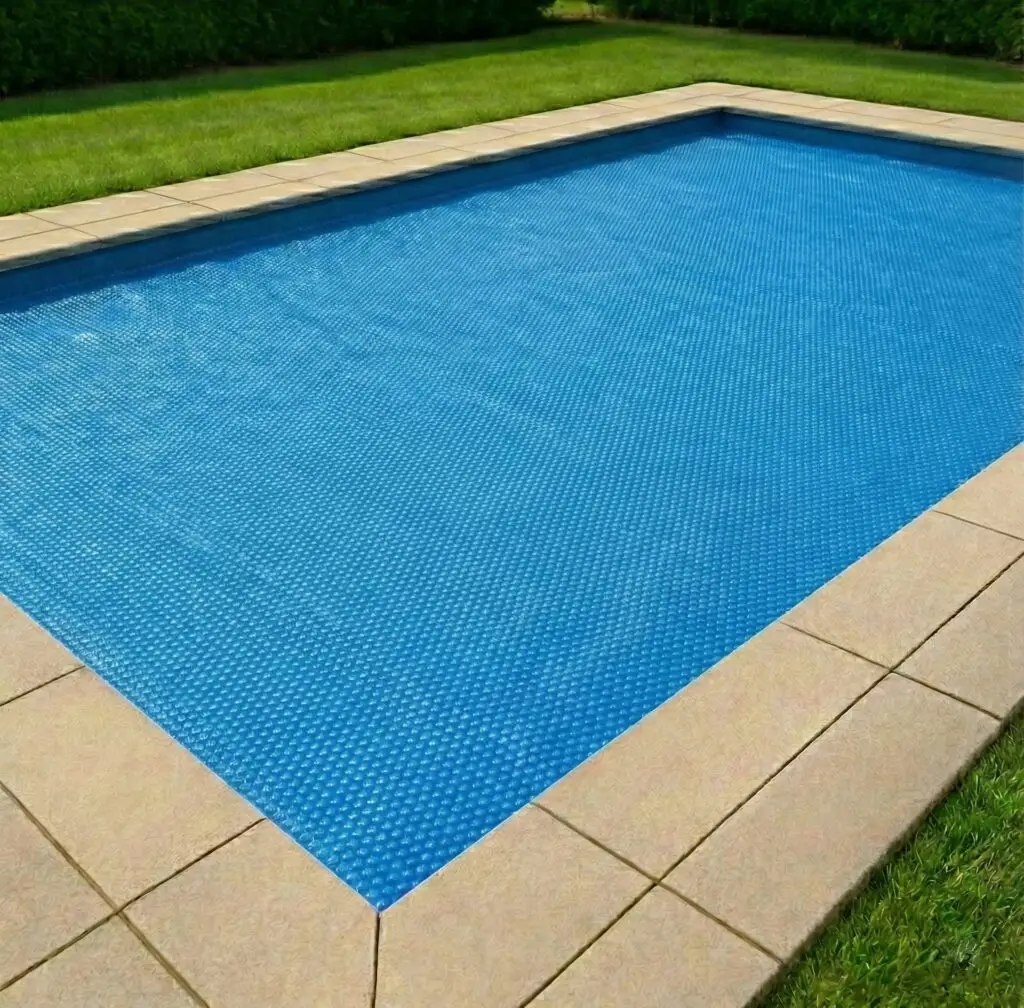
- It keeps the heat you’ve paid for in the water. A 500 micron blanket on the pool overnight sharply reduces evaporation, which would otherwise swallow most of your heat pump’s effort.
- It collects free heat in the daytime. A quality solar blanket soaks up sunshine and transfers that warmth into the pool, often adding several degrees before the heat pump even starts.
- It can mean a smaller heat pump. A covered pool has a far lower heat load, which can be the difference between needing the next size up and getting away without it.
- It trims running costs from both sides. With less heat to replace, the compressor runs fewer hours, and the hours it does run are at lower speed and higher COP.
- It saves water and chlorine as well. Less evaporation means less topping up, and less sun on the water means chlorine burns off more slowly.
Put simply: install a heat pump without a solar blanket and the running cost will disappoint you, and the heat pump won’t be to blame. That’s why we suggest the two together every time. Our recommended cover is the TriTherm 500 micron solar blanket, and adding a roll-up station from the solar blankets and roll-up stations range turns “I really should cover the pool” into a half-minute routine you’ll actually stick to every evening.
Fairland against the rest: a side-by-side comparison
We recommend Fairland because, on the specs that count, nothing else at a similar price comes near it. That’s a strong statement, so here’s the evidence next to two typical alternatives on the South African market: a premium full-inverter model from a big international brand that goes head to head with the InverX20, and a popular conventional heat pump from a familiar local air-conditioning brand, the sort that sells in large numbers at about the same price as a Comfortline. All figures come from each manufacturer’s own published specifications, measured at the same standard 26°C to 27°C air and water conditions.
| Model | Category | Best COP (low speed) |
COP at full power | Lowest air temperature it heats in | Sustainable gain over ambient (correctly sized, blanket on) |
|---|---|---|---|---|---|
| Fairland InverX20 | Full inverter | 20 | 7 to 8 | −20°C | 10 to 12°C, all year |
| Competitor A premium full inverter |
Full inverter | About 15 | About 7 | −10°C | About 10°C |
| Fairland Comfortline | Stepped inverter | 9 | Varies output from 20% to 100% | 0°C | 8 to 10°C |
| Competitor B popular local-brand conventional unit |
On/off | About 6 | About 6 (single speed) | Not published | 6 to 8°C, lower in winter |
| Typical entry-level on/off unit | On/off | 4 to 5 | 4 to 5 (single speed) | Varies, frequently about 5°C | 5 to 7°C, summer only |
Gain over ambient is how far above the average daily air temperature a unit can keep the pool once it’s warm, assuming a solar blanket goes on overnight and the unit is matched to the pool size. It reflects practical experience from installations around the country rather than a laboratory measurement. Pools that are uncovered, windswept or fitted with an undersized unit will see less.
Start with the first row. At peak efficiency the InverX20 isn’t marginally ahead: it’s a third more efficient than the best rival full inverter with a published figure we could find, and over three times as efficient as the conventional units most buyers end up with. In cold weather it’s in a class of its own, carrying on heating in air ten degrees colder than its nearest competitor can handle. If low running costs and year-round swimming are why you’re buying a heat pump, this is the benchmark. It’s also the only model in the table that keeps its full gain over ambient through a Highveld winter instead of tailing off as temperatures drop.
Next, compare the Comfortline with its real price rival. Competitor B represents what most South African pools end up with: a dependable, conventional on/off heat pump from a well-known name, sold through air-conditioning and hardware outlets for roughly what a Comfortline costs. With a single speed, its COP of about 6 is as good as it ever gets. The Comfortline’s peak of 9 is 50% higher, and since it can throttle down to 20% output, it spends most of its running time in the low-speed, high-efficiency band that a single-speed unit simply can’t reach. Factor in a spiral titanium exchanger with 30% more surface area, operation up to seven times quieter, and the same build quality as the InverX20, and we’d argue the Comfortline is the best heat pump available at its price, and one of very few genuine inverters in that bracket at all.
Within its price bracket, nothing beats the Comfortline. Across every bracket, nothing beats the InverX20.
Meet the two Fairland ranges
There are two Fairland ranges in our line-up because there are two kinds of buyer. One wants a sensible, efficient heat pump for an ordinary family pool. The other wants the lowest possible running cost and the quietest possible operation, and is happy to spend more at the start to get them.
Best value for most pools
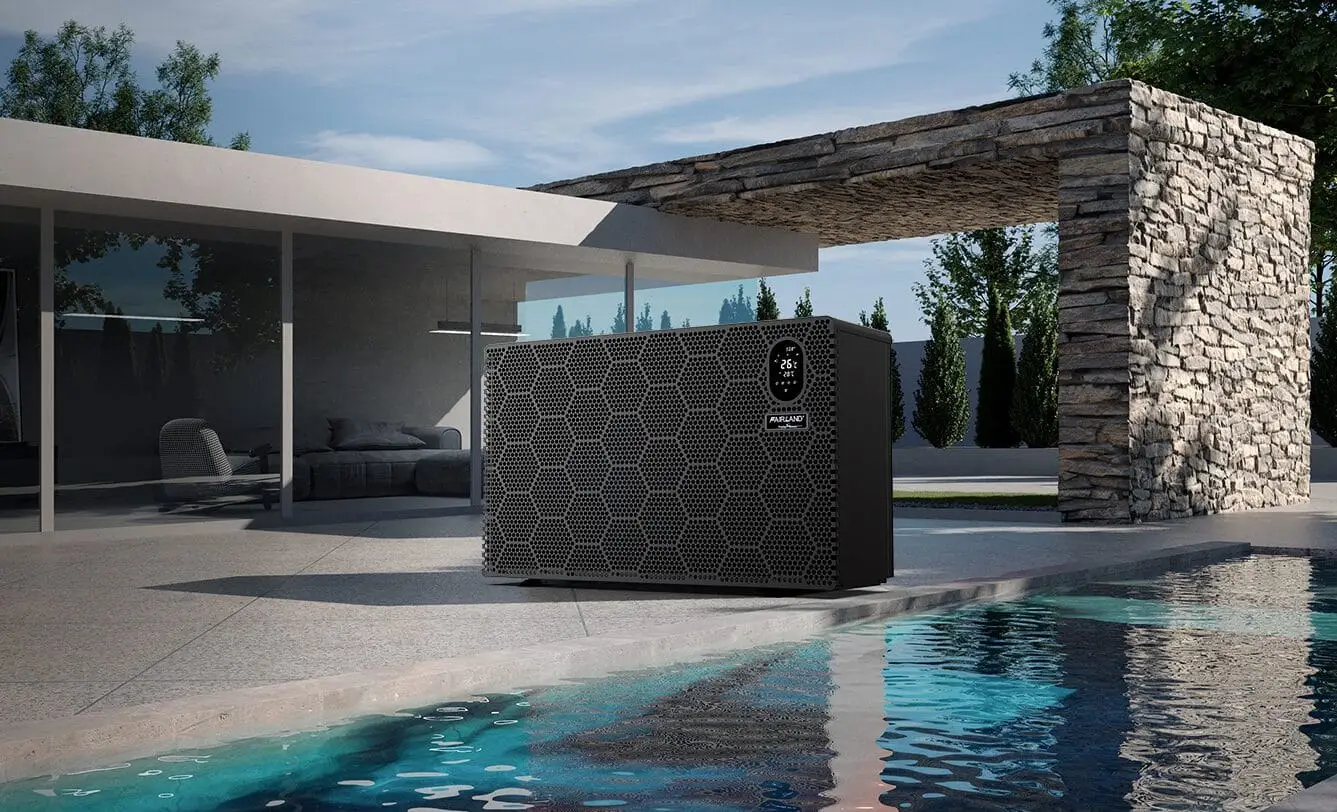
Fairland Comfortline Inverter Heat Pump
The Comfortline is a stepped inverter heat pump: its compressor scales output anywhere from 20% to 100% depending on what the pool needs, so once the first warm-up is done it mostly runs gently and quietly instead of clicking on and off. HP-Booster technology and a spiral titanium heat exchanger with 30% more surface area than a standard coil lift its peak COP to 9, and it operates up to seven times more quietly than a conventional on/off heat pump. Wi-Fi control through the smartphone app comes standard, so you can start warming the pool before you get home.
- Stepped inverter, 20% to 100% output
- Peak COP of up to 9
- Spiral titanium heat exchanger
- Up to 7× quieter than on/off units
- App control over Wi-Fi included
- 220 V, single phase
- Works in air from 0°C to 43°C
- Auto defrost and soft start
Available in six sizes: 7 kW (pools up to 28,000 L), 9 kW (35,000 L), 13 kW (55,000 L), 17 kW (70,000 L), 21 kW (100,000 L) and 24 kW (120,000 L). Ask your nearest branch for trade pricing.
See the Comfortline rangeMaximum efficiency
Fairland InverX20 Full-Inverter Heat Pump
The InverX20 is a full-inverter heat pump, and its name gives away its party trick: a peak COP of 20 when it’s running at low speed to keep your pool at temperature. As far as we know, that’s the highest published COP of any residential pool heat pump on sale in South Africa. Even flat out on a cool day it holds a COP of 7 to 8, which is the ceiling for lesser units. It achieves this with Fairland’s 3D heat-exchange technology, a 3D spiral titanium exchanger and controls that adjust the compressor, fan and refrigerant flow together. Three modes set its behaviour: Turbo for a quick warm-up, Smart to let the unit choose, and Silence for evenings when you’d prefer not to hear it. It also carries on heating in air as cold as −20°C, something the Comfortline can’t do, which makes it the pick for a true year-round pool on the Highveld.
- Full inverter with continuous modulation
- COP up to 20 at low speed
- COP of 7 to 8 at full output
- Turbo, Smart and Silence modes
- 3D spiral titanium heat exchanger
- Works in air from −20°C to 43°C
- App control over Wi-Fi included
- Turbo mode pushes output beyond rated
Available in two sizes: 6 kW (up to 9 kW in Turbo, for pools up to 35,000 L) and 13 kW (up to 18 kW in Turbo, for pools up to 65,000 L). Ask your nearest branch for trade pricing.
See the InverX20Comfortline or InverX20?
For the majority of pools in the majority of regions, the Comfortline is the one to buy. It’s a genuine inverter with a strong COP, it runs quietly, and its six sizes cover everything from a small plunge pool to a very large family pool. The InverX20 costs noticeably more up front, and it earns that premium back in two cases: when you plan to keep heating through the coldest months of a Gauteng or Free State winter, where its sub-zero operating range and better cold-weather efficiency really count, or when the unit will stand close to a bedroom window or a neighbour’s boundary wall and quiet running is worth paying for. If neither applies to you, spend the difference on a blanket and roll-up station instead, and you’ll swim in warmer water for less.
Going a size smaller to save money costs more in the end
The mistake we see most often is buying a heat pump one size too small. An undersized unit runs at 100% around the clock just to keep pace, which is its noisiest and least efficient setting, and in winter it may never reach the temperature you’re after. An inverter unit one size larger than strictly needed spends its life idling at low speed and high COP. If your pool falls between two sizes, choose the bigger one. If it’s fully shaded, exposed to wind, or you plan to swim through winter, step up another size.
Five habits for a happier heat pump
Even the best heat pump depends on how it’s installed and how you use it. These points are what separate satisfied owners from frustrated ones.
-
Let it breathe
The unit warms your pool by extracting heat from the air flowing through it, so it needs plenty of airflow. Keep the space in front of the fan outlet and around the intake clear, never enclose it, and make sure it can’t draw its own cold exhaust back in. A heat pump squeezed into a corner under a lean-to is fighting with one hand tied behind its back.
-
Plumb in a bypass
The heat pump is connected after your filter on the return line, with a bypass that lets you control how much water passes through it and isolate it for servicing or draining for winter. Too much flow is just as unhelpful as too little; your installer will set the bypass so the exchanger gets the flow rate the unit was designed for.
-
Run the filter pump with it, and for longer
A heat pump heats only while water is moving through it, so your filter pump must be on whenever the heat pump is. Inverter models prefer long hours at low speed over short blasts at full power. If your pump runs on a timer, lengthen the schedule. A variable-speed pool pump makes this easy and inexpensive.
-
Choose a realistic set point and stick with it
Each degree above 28°C costs disproportionately more to maintain, because the gap between water and air grows and the pool sheds heat faster. Decide on the temperature you genuinely enjoy swimming in, set it once and avoid creeping it upwards. The app makes it simple to lower it a few degrees while you’re away.
-
Cover the pool every single night
If you remember only one thing from this guide, let it be this. The blanket decides whether your heat pump quietly holds temperature on a trickle of electricity or battles the night sky and loses. With a roll-up station, covering the pool takes less time than brushing your teeth.
Heat pump questions we hear at the counter
Should I choose a heat pump or solar panels?
Each does a different job. Solar panels are almost free to run, but they only work when the sun is out and can’t maintain a set temperature. A heat pump gives you thermostat control and keeps working at night and on overcast days. Many pools use both: the panels carry the load on sunny days and the heat pump tops up and holds the temperature. In either case, a blanket helps both work better.
Does a heat pump cope with a Highveld winter?
The Comfortline runs in air down to 0°C and the InverX20 down to −20°C, so both keep going through a Johannesburg or Pretoria winter. Output and efficiency both fall as the air cools, so expect a slower warm-up, higher running costs and a lower settled temperature in June and July than in October. Keep in mind that the unit maintains a gain over ambient rather than a fixed temperature: a pool sitting at 29°C in January will settle in the low twenties in July with the same unit and the same set point. In winter a solar blanket is essential, not a nice-to-have, and if you want to swim all year, size up and lean towards the InverX20.
How long before a cold pool is warm enough to swim?
Allow two to five days for the first lift from winter-cold to swimming temperature, depending on the pool’s size, the unit’s size, the weather and whether the pool is covered. From then on it’s only maintenance, with the unit running at low speed for a few hours a day to replace the heat that’s been lost.
Is a heat pump compatible with a salt chlorinator?
Yes. Both Fairland ranges use titanium heat exchangers precisely because titanium resists salt, chlorine and the rest of the chemistry in pool water. Keep your water balanced as usual and the exchanger will outlive the other components of the unit.
Is the Wi-Fi control genuinely useful?
More than you might expect. Lowering the set point by a few degrees while you’re away for a week and raising it again the day before you get back is a real saving, and you’ll only bother if it’s a tap on your phone. Putting the InverX20 into Silence mode for an evening braai works the same way.
Can I fit it myself?
A capable DIYer with a bypass kit can handle the plumbing, but the electrical connection must be done by a qualified electrician, and bigger units need their own dedicated circuit. Most owners have a pool installer do the full job in half a day. Always keep the unit upright while moving and installing it, because tipping it over can damage the compressor.
1 US Department of Energy, Energy Saver: “Swimming Pool Covers” and “Heat Pump Swimming Pool Heaters”. COP test conditions and product specifications as published by each manufacturer; competitor figures are from their South African distributors’ published spec sheets at the time of writing. Heating calculations use the specific heat capacity of water (4.186 kJ/kg·°C, which equals 1.16 kWh per 1,000 L per °C).
Warmer water, lower bills, and a heat pump you’ll hardly hear.
Pop into your nearest Pool Trade branch in Gauteng, Pretoria, KZN, the Western Cape, Windhoek or Grand Baie to talk through the Comfortline and InverX20 ranges. Trade and public welcome. Not sure which size you need? Call or WhatsApp 066 503 7475 with your pool’s dimensions and we’ll point you to the right unit.